Demis Hassabis is the co-founder and CEO of Google DeepMind and a 2024 Nobel laureate in Chemistry, recognized jointly with John Jumper for their work on AlphaFold and protein-structure prediction.
In his recent essay, “A Framework for Frontier AI and the Dawning of a New Age”, he proposes a shared standards body for frontier AI.
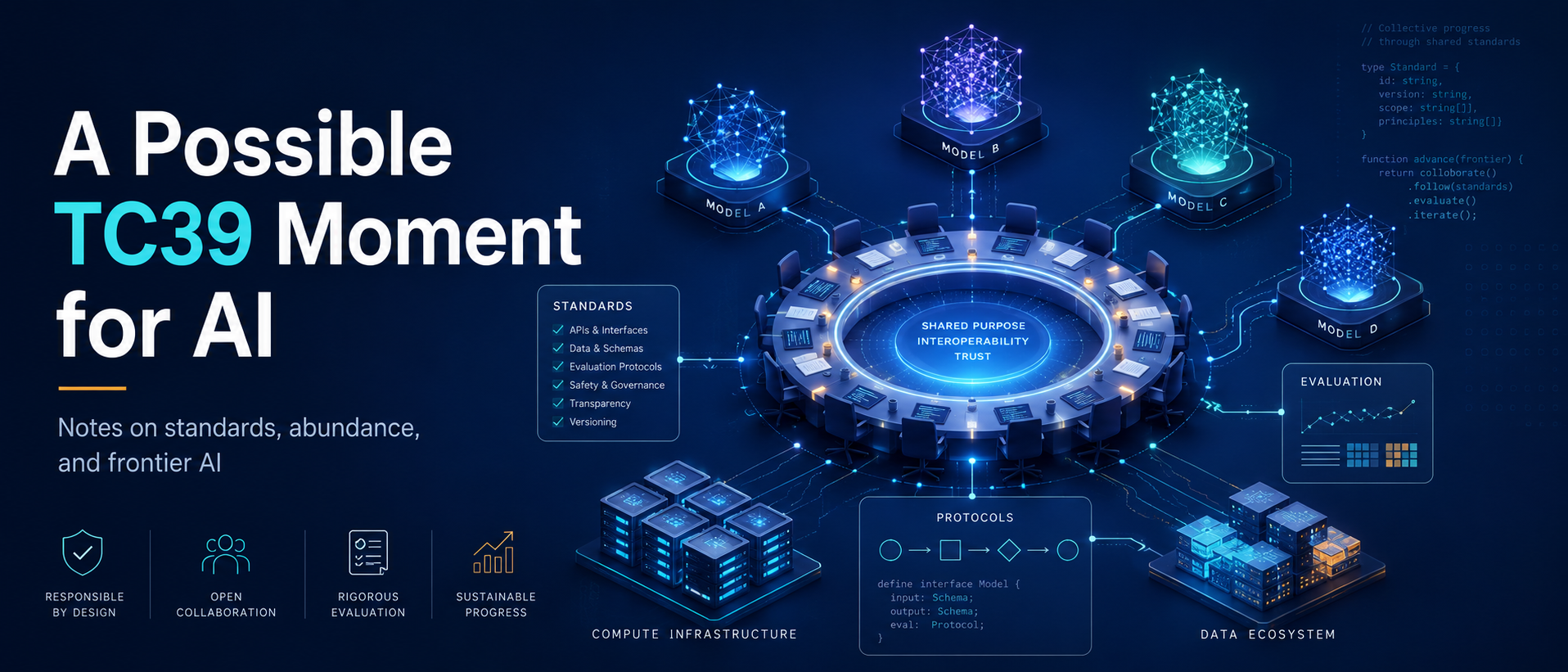
This is not a summary of his broader essay, but a few notes on one idea that stood out to me: Is AI approaching something like a TC39 moment?
For engineers, TC39 is a useful starting comparison. It gives competing companies, implementers and experts a shared process for evolving JavaScript. Companies continue to compete through their products, but collaborate on the standards that allow the wider ecosystem to function.
Frontier AI may now need a similar coordination layer.
Google DeepMind, OpenAI, Anthropic and other labs will continue competing on model capabilities. That competition is important. However, as models become more autonomous, operate tools and take on increasingly complex work, some questions cannot be answered independently by every company:
- How should frontier capabilities and risks be evaluated?
- What safety evidence should accompany a release?
- How should serious incidents be reported?
- When should independent testing be required?
The TC39 comparison is useful, but incomplete. TC39 primarily develops a technical standard. An AI institution may also need security testing, incident coordination, risk evaluation and the authority to recommend delaying a release.
It might therefore resemble a combination of TC39, NIST and a FINRA-style industry body rather than any single existing organization. Hassabis’s proposal specifically points toward a public-private standards body capable of evaluating frontier models before deployment.
Why does this matter now?
Civilizations tend to progress when important resources move from scarcity toward abundance. Information has already become abundant. What remains scarce is our ability to evaluate it, connect it to the right context and turn it into meaningful action.
AI may make parts of intelligence and execution more abundant: analyzing information, writing software, conducting research and completing complex tasks.
That could unlock enormous progress. But abundance does not govern itself.
A shared AI institution would not be perfect. It could become slow, political or dominated by the largest labs. It might also create barriers for smaller or open-source participants.
Yet allowing every frontier lab to define, test and approve its own safety standards does not seem sustainable either.
Perhaps this is AI’s TC39 moment.
Or perhaps AI needs something more ambitious: an institution that does not merely standardize how systems work, but helps determine whether increasingly capable systems are ready to be released.
The technology is advancing quickly. The institutions around it are still being designed.
The future is not yet written.